|
Can you tell our audience about Zodiac Gold’s Todi project?
Zodiac Gold is a TSXV-listed gold explorer focused on developing the regional-scale Todi project in Liberia. The company is advancing a 14,000-m drilling program in 2026 at the asset, having completed 3,542 m across 20 holes as of early July.
Todi sits an hour north of Monrovia on a paved road and an hour from the port, with an active rail line 5 km from our current targets and an active hydroelectric plant within 5 km that can expand to 40 MW. Our asset covers 2,316 km2 and borders Avesoro's New Liberty mine, the second-largest gold mining operation in West Africa. Todi also has iron ore and pegmatite-hosted critical mineral expressions. We believe Todi is a generational opportunity: it has the potential to become a 5 to 10 million oz deposit producing at the scale of New Liberty.
What are Zodiac Gold’s operational priorities at present?
We are conducting a 14,000-m drill program with two rigs, covering a strike zone of about 11 km. In Zodiac’s most recent drill program, 37 of 39 holes at Arthington hit mineralization, and we are seeing the same trends emerge now. Our priority is to turn the assays around as quickly as possible, so that we can formally define our resource. We expect to establish a first mineral resource estimate (MRE) by the end of 2026, and to further grow our resource through future programs.
How does Liberia stack up against other African mining jurisdictions in 2026?
Liberia’s business environment is excellent for mining. The country has solid banking infrastructure and a supportive regulator. In contrast to other West African jurisdictions like Burkina Faso or Mali, which were poster children for stability two decades ago but now suffer from instability, Liberia has had a stable democracy for more than two decades since its civil war ended in 2003. The country has witnessed numerous peaceful transitions of power and was the first country in Africa to elect a woman, Ellen Johnson Sirleaf, as president.
I have decades of experience building mines across Africa, and I can confidently put Liberia up there with Botswana as a premier jurisdiction for mining. Liberia is a preeminent emerging market in a very stable environment.
Additionally, from a technical perspective, Liberia is underdeveloped compared to the quality of its geology. It lies at the western end of the Birimian greenstone belt, where there are 100 mining companies in Côte d'Ivoire, over 350 in Ghana, and more than 200 in each of Burkina Faso and Mali, though those numbers are falling. Meanwhile, Liberia has fewer than 40 tier one and tier two companies, meaning there is ample opportunity for more companies to explore opportunities in the country.
What is the latest status on Zodiac’s mineral development agreement negotiations with the government?
We are currently transitioning our exploration rights into a full mineral development agreement (MDA) with the Liberian government. An MDA in Liberia is a mining convention passed into law: neither party can unilaterally change it, and it is enforceable through arbitration in Paris or the International Chamber of Commerce. Liberian MDAs are valid for 25 years, with 25-year renewals. Right now, we expect the government to receive a 3% royalty and 25% corporate tax, with the government’s free-carry interest expected to land between 20 and 25%.
How is the 2026 gold price environment shaping the way investors value explorers?
The fundamentals for gold have never been better. Five years ago, a US$3,000/oz gold price would have sounded outlandish, and yet gold surpassed US$5,000/oz in early 2026. The recent pullback and consolidation at US$4,000/oz has solidified our house view that gold will continue to rally. When gold runs, mining companies take five steps forward, but they take even more steps back when the price falls. Whether you look at cash flow multiples of producers, or dollars per oz of inferred or measured and indicated resources, valuations today are at all-time lows: gold has moved from US$1,800/oz to US$4,000/oz, yet mining companies still trade at a multiple of US$20/oz.
My view is that we are in the second inning of a nine-inning baseball game. Sovereign debt is rising, foreign governments are no longer buying US Treasuries, and the US dollar is shifting away from its role as the world's reserve currency. Gold has been a stable currency for 4,000 years, and these macroeconomic shifts will be very good for gold and for the companies that can prove ounces in the ground now.
What are your priorities and the catalysts to watch for Zodiac Gold over the coming year?
Stability should return to markets at the current consolidated commodity price levels. Instability creates environments prone to selloffs, and investor appetite is not yet where it can be.
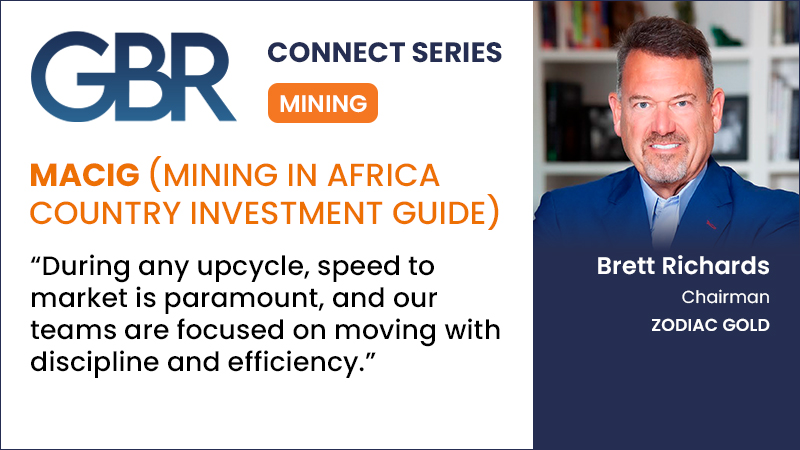
For Zodiac, this means we must prioritize having the right people doing the right things at the right time. Zodiac will complete its MRE as accurately and as quickly as possible, so that we can tell our story and receive fair valuation from markets. During any upcycle, speed to market is paramount, and our teams are focused on moving with discipline and efficiency.
|